
"Battle" Effects and <Piercing>
Does a security check happen in a battle without an attack?
EX11 and BT25 brought more effects like "this Digimon may battle 1 of your opponent's Digimon" — effects that cause a battle directly, without any attack. If a Digimon with <Piercing> wins one of these battles, does a security check happen, and if so, when? Let's sort it out.
What a "battle" effect actually is
- Official Q&A defines these as effects that directly cause a "battle." When activated, the chosen Digimon battle each other following the normal rules.
- A battle means comparing the DP of the two battling cards (Comprehensive Rules 14-1). The one with lower DP loses and is immediately deleted; if the DP is tied, both lose.
- The key point: only a battle happens. No attack is declared, so there is no [Counter] timing, no blocking with <Blocker>, and no security check from an attack.
Example cards:
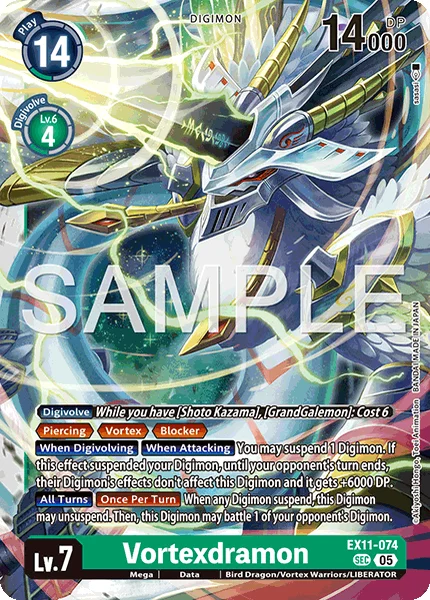
- EX11-074 Vortexdramon: [All Turns] effect — "this Digimon may battle 1 of your opponent's Digimon"
- BT25-057 Monarchlizamon: [When Digivolving] — "this Digimon may battle 1 of your opponent's Digimon"
- BT25-020 Marsmon: [On Play] [When Digivolving] [When Attacking] — "1 of your Digimon and 1 of your opponent's Digimon may battle"
- A battle means comparing the DP of the two battling cards (Comprehensive Rules 14-1). The one with lower DP loses and is immediately deleted; if the DP is tied, both lose.
- The key point: only a battle happens. No attack is declared, so there is no [Counter] timing, no blocking with <Blocker>, and no security check from an attack.
Example cards:
- EX11-074 Vortexdramon: [All Turns] effect — "this Digimon may battle 1 of your opponent's Digimon"
- BT25-057 Monarchlizamon: [When Digivolving] — "this Digimon may battle 1 of your opponent's Digimon"
- BT25-020 Marsmon: [On Play] [When Digivolving] [When Attacking] — "1 of your Digimon and 1 of your opponent's Digimon may battle"



Read the <Piercing> condition carefully
The Comprehensive Rules define <Piercing> as follows:
"When this attacking Digimon deletes your opponent's Digimon in battle, it checks security immediately before the attack ends" (Comprehensive Rules 16-7-1).
Two things to take away:
1. The condition includes "attacking" — <Piercing> only triggers in a battle during that Digimon's own attack.
2. The check happens "immediately before the attack ends" — not right after winning the battle. <Piercing> is pending processing that resolves just before the end of the attack (16-7-4).
"When this attacking Digimon deletes your opponent's Digimon in battle, it checks security immediately before the attack ends" (Comprehensive Rules 16-7-1).
Two things to take away:
1. The condition includes "attacking" — <Piercing> only triggers in a battle during that Digimon's own attack.
2. The check happens "immediately before the attack ends" — not right after winning the battle. <Piercing> is pending processing that resolves just before the end of the attack (16-7-4).
Case by case: does a security check happen?
- Case 1: A "battle" effect causes a battle while no attack is happening
→ <Piercing> does not trigger, because there is no attack. Even if you win and delete the opponent's Digimon, no security check happens.
(Example: You digivolve into Monarchlizamon during your main phase and its [When Digivolving] effect battles and deletes an opponent's Digimon.)
- Case 2: A "battle" effect causes a battle during the <Piercing> Digimon's own attack
→ <Piercing> triggers. Official Q&A: during an attack by a Digimon with <Piercing>, <Piercing> triggers even for battles other than the one from the attack itself.
Note that the security check still happens immediately before the attack ends, not right after the battle.
- Case 3: During a single attack, you delete opponent Digimon both in an effect battle and in the attack battle
→ Even if <Piercing> activates multiple times, only 1 security check can happen per attack (16-7-5).
- Case 4: During another Digimon's attack, a different Digimon with <Piercing> battles via an effect
→ Does not trigger. <Piercing> only triggers when that Digimon itself deletes an opponent's Digimon in battle during its own attack.
→ <Piercing> does not trigger, because there is no attack. Even if you win and delete the opponent's Digimon, no security check happens.
(Example: You digivolve into Monarchlizamon during your main phase and its [When Digivolving] effect battles and deletes an opponent's Digimon.)
- Case 2: A "battle" effect causes a battle during the <Piercing> Digimon's own attack
→ <Piercing> triggers. Official Q&A: during an attack by a Digimon with <Piercing>, <Piercing> triggers even for battles other than the one from the attack itself.
Note that the security check still happens immediately before the attack ends, not right after the battle.
- Case 3: During a single attack, you delete opponent Digimon both in an effect battle and in the attack battle
→ Even if <Piercing> activates multiple times, only 1 security check can happen per attack (16-7-5).
- Case 4: During another Digimon's attack, a different Digimon with <Piercing> battles via an effect
→ Does not trigger. <Piercing> only triggers when that Digimon itself deletes an opponent's Digimon in battle during its own attack.
Digivolving mid-attack (Arts Digivolve)
The [Main] effect of "Final Judgment" makes one of your Digimon attack. Unlike "battle" effects, an actual attack happens, so it proceeds like any normal attack.
In a Glowing Dawn deck, <Piercing> plays out differently in these two lines:
- Digivolve into Monarchlizamon during your main phase → the [When Digivolving] battle is not a battle during an attack → <Piercing> doesn't trigger
- A Lv.4 Digimon attacks via "Final Judgment," then Arts Digivolves into Monarchlizamon mid-attack → the [When Digivolving] battle is now a battle during its own attack → if it gained <Piercing> from inherited effects like Gekkomon (BT25-046) or Armalizamon (BT25-049), <Piercing> triggers and checks security immediately before the attack ends
A digivolved Digimon is considered the same single Digimon as before digivolving (8-1-2-3), so digivolving mid-attack keeps it as "the attacking Digimon."
In a Glowing Dawn deck, <Piercing> plays out differently in these two lines:
- Digivolve into Monarchlizamon during your main phase → the [When Digivolving] battle is not a battle during an attack → <Piercing> doesn't trigger
- A Lv.4 Digimon attacks via "Final Judgment," then Arts Digivolves into Monarchlizamon mid-attack → the [When Digivolving] battle is now a battle during its own attack → if it gained <Piercing> from inherited effects like Gekkomon (BT25-046) or Armalizamon (BT25-049), <Piercing> triggers and checks security immediately before the attack ends
A digivolved Digimon is considered the same single Digimon as before digivolving (8-1-2-3), so digivolving mid-attack keeps it as "the attacking Digimon."


"When this Digimon wins a battle" is not <Piercing>
Marsmon (BT25-020) has "[All Turns] [Once Per Turn] When your Digimon with the [TS] trait wins a battle, trash the top card of your opponent's security stack."
- This is a "wins a battle" trigger — a different thing from <Piercing>. Whether an attack is happening is not part of the condition, so it triggers even when the battle came from a "battle" effect.
- What it does is "trash," not a "security check." [Security] effects of trashed cards do not activate (except cards that say they activate "when trashed from security").
- The end result — the security stack shrinking by one — looks similar, but a check (which activates [Security] effects) and trashing (which doesn't) are treated as different things.
- This is a "wins a battle" trigger — a different thing from <Piercing>. Whether an attack is happening is not part of the condition, so it triggers even when the battle came from a "battle" effect.
- What it does is "trash," not a "security check." [Security] effects of trashed cards do not activate (except cards that say they activate "when trashed from security").
- The end result — the security stack shrinking by one — looks similar, but a check (which activates [Security] effects) and trashing (which doesn't) are treated as different things.
Relevant Comprehensive Rules sections
- 16-7-1: <Piercing> checks security immediately before the attack ends when this attacking Digimon deletes an opponent's Digimon in battle
/en/quiz/general-rule/16#16-7-1
- 16-7-4: <Piercing> is pending processing resolved immediately before the end of the attack
/en/quiz/general-rule/16#16-7-4
- 16-7-5: Even with multiple <Piercing> activations, only 1 security check per attack
/en/quiz/general-rule/16#16-7-5
- 14-1: A battle refers to comparing the DP of the two battling cards
/en/quiz/general-rule/14#14-1
- 14-2-2: The Digimon that loses the battle is immediately deleted
/en/quiz/general-rule/14#14-2-2
- 8-1-2-3: A digivolved Digimon is considered a single Digimon including its digivolution cards
/en/quiz/general-rule/8#8-1-2-3
/en/quiz/general-rule/16#16-7-1
- 16-7-4: <Piercing> is pending processing resolved immediately before the end of the attack
/en/quiz/general-rule/16#16-7-4
- 16-7-5: Even with multiple <Piercing> activations, only 1 security check per attack
/en/quiz/general-rule/16#16-7-5
- 14-1: A battle refers to comparing the DP of the two battling cards
/en/quiz/general-rule/14#14-1
- 14-2-2: The Digimon that loses the battle is immediately deleted
/en/quiz/general-rule/14#14-2-2
- 8-1-2-3: A digivolved Digimon is considered a single Digimon including its digivolution cards
/en/quiz/general-rule/8#8-1-2-3
Key point <Piercing> only triggers in battles during that Digimon's own attack. A "battle" effect without an attack never causes a security check, no matter how decisively you win. And even when it does trigger, the check happens "immediately before the attack ends," not right after the battle.