
The Security Trio, Untangled: Checks, [Security] Effects, {Security} Effects
Three confusable security mechanics, split apart by the official rules
Around the security stack, the vocabulary piles up: "security check," "[Security] effect," "{Security} effect," "when your security stack decreases." Each is a distinct mechanic with its own rules section (Chapter 13 / 15-16-10 / 15-14-5). Mixing them up leads straight to misplays — here's the clean separation.
The four, side by side
- **Security check** (13-1-1): the check performed when an attack lands. Once per attack.
- **[Security] effect** (15-16-10-1): triggers the moment that card is CHECKED. Activates immediately, no pending (15-16-10-2).
- **{Security} effect** (15-14-5-1): can trigger and activate while the card sits **face-up** in the security stack.
- **"When your security stack decreases"**: a trigger condition catching the count going down — by check or by effect.
Similar words, four different rules.
- **[Security] effect** (15-16-10-1): triggers the moment that card is CHECKED. Activates immediately, no pending (15-16-10-2).
- **{Security} effect** (15-14-5-1): can trigger and activate while the card sits **face-up** in the security stack.
- **"When your security stack decreases"**: a trigger condition catching the count going down — by check or by effect.
Similar words, four different rules.
Security check basics (13-1)
How checks work:
- Performed when an attack on the opponent PLAYER lands and their security stack has 1+ cards (11-5-1-1-1)
- Only 1 security check per attack (13-1-2). With <Security A. +X> and similar modifiers, that single check covers the modified number of cards
- Cards are checked one at a time (13-1-3)
- Once the situation calls for a check, checking is mandatory (13-1-4)
- A checked card leaves the security stack and belongs to no area (13-1-6)
- A checked Digimon card is treated as a Security Digimon (13-1-7)
<Piercing> adds a check of its own — see the companion column on "battle" effects and <Piercing>.
- Performed when an attack on the opponent PLAYER lands and their security stack has 1+ cards (11-5-1-1-1)
- Only 1 security check per attack (13-1-2). With <Security A. +X> and similar modifiers, that single check covers the modified number of cards
- Cards are checked one at a time (13-1-3)
- Once the situation calls for a check, checking is mandatory (13-1-4)
- A checked card leaves the security stack and belongs to no area (13-1-6)
- A checked Digimon card is treated as a Security Digimon (13-1-7)
<Piercing> adds a check of its own — see the companion column on "battle" effects and <Piercing>.
[Security] effects: once, on check (15-16-10)
A [Security] effect (15-16-10-1) triggers **the moment its card is checked**.
- It activates immediately, without pending activation (15-16-10-2)
- Even alongside simultaneous triggers, [Security] effects take precedence
- The checked card has left its area (13-1-6), so as a rule it fires exactly once
Example: the [Security] effect on a typical Lv.4 Digimon card ("1 of your opponent's Digimon gets -3000 DP" etc.) activates the moment it's revealed from security, and the card then proceeds to deletion, the hand, or wherever its processing sends it.
- It activates immediately, without pending activation (15-16-10-2)
- Even alongside simultaneous triggers, [Security] effects take precedence
- The checked card has left its area (13-1-6), so as a rule it fires exactly once
Example: the [Security] effect on a typical Lv.4 Digimon card ("1 of your opponent's Digimon gets -3000 DP" etc.) activates the moment it's revealed from security, and the card then proceeds to deletion, the hand, or wherever its processing sends it.
{Security} effects: as long as it sits face-up (15-14-5)
A {Security} effect (15-14-5-1) can trigger and activate **any number of times while the card is placed face-up in the security stack**.
- Security is normally face-DOWN, so a {Security} card does nothing until some effect places it **face-up**
- ST22-10 Amethyst Mandala's own [Main] effect includes "place this card face up at the bottom of your security stack," keeping its {Security} effect live
- Multiple face-up copies can each trigger simultaneously
More in the companion column on "would leave" effects and simultaneous triggers.
- Security is normally face-DOWN, so a {Security} card does nothing until some effect places it **face-up**
- ST22-10 Amethyst Mandala's own [Main] effect includes "place this card face up at the bottom of your security stack," keeping its {Security} effect live
- Multiple face-up copies can each trigger simultaneously
More in the companion column on "would leave" effects and simultaneous triggers.

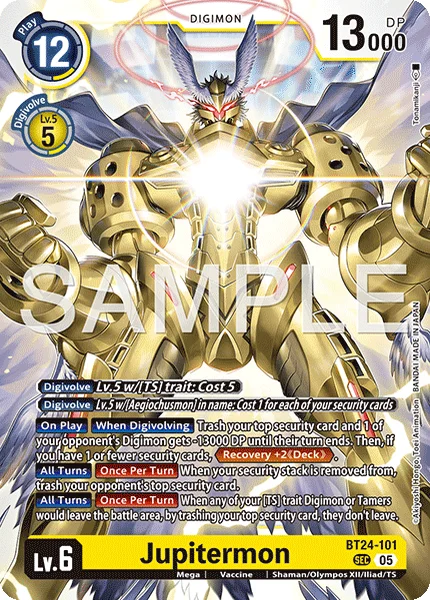
"When your security stack decreases" (BT24-101 Q5718)
BT24-101 Jupitermon's [All Turns] [Once Per Turn] effect:
"When your security stack decreases, trash the top card of your opponent's security stack."
- Triggers whenever your security count drops — by check, by effect trashing, either way
- With [Once Per Turn], it activates up to once during your turn and once during your opponent's
- Jupitermon ALSO has "when your Digimon/Tamer with the [TS] trait would leave the battle area, by trashing the top card of your security stack, they don't leave" — trash one security to save an ally, and the first effect catches that very decrease, trashing one of the opponent's security in return
Note: "when your security stack decreases" is a trigger condition (a timing) — a different concept from "security check." It catches both checks and effect-based decreases.
"When your security stack decreases, trash the top card of your opponent's security stack."
- Triggers whenever your security count drops — by check, by effect trashing, either way
- With [Once Per Turn], it activates up to once during your turn and once during your opponent's
- Jupitermon ALSO has "when your Digimon/Tamer with the [TS] trait would leave the battle area, by trashing the top card of your security stack, they don't leave" — trash one security to save an ally, and the first effect catches that very decrease, trashing one of the opponent's security in return
Note: "when your security stack decreases" is a trigger condition (a timing) — a different concept from "security check." It catches both checks and effect-based decreases.

The checklist and rules sections
When in doubt, identify which of the four you're in:
1. A security check? → the 13-1 procedure (one per attack, one card at a time, mandatory, [Security] effects trigger on check)
2. A card's [Security] effect? → 15-16-10: once, on check, immediate
3. A card's {Security} effect? → 15-14-5: anytime while face-up in security
4. A "security decreased" trigger? → a timing trigger; catches checks AND trashes
Sections:
- 11-5-1... (attack landing; when checks happen)
- 13-1-1 to 13-1-8 (the full check procedure)
- 15-16-10-1 to 2 ([Security] effects)
- 15-14-5-1 ({Security} effects)
1. A security check? → the 13-1 procedure (one per attack, one card at a time, mandatory, [Security] effects trigger on check)
2. A card's [Security] effect? → 15-16-10: once, on check, immediate
3. A card's {Security} effect? → 15-14-5: anytime while face-up in security
4. A "security decreased" trigger? → a timing trigger; catches checks AND trashes
Sections:
- 11-5-1... (attack landing; when checks happen)
- 13-1-1 to 13-1-8 (the full check procedure)
- 15-16-10-1 to 2 ([Security] effects)
- 15-14-5-1 ({Security} effects)
Key point Four mechanics share the "security" name: checks, [Security] effects, {Security} effects, and "security decreased" triggers — each with its own rules. Square brackets [ ] = once, on check. Curly braces { } = continuously, while face-up. Don't let the brackets blur.