

Dual Cards: Is That Effect a "Digimon Effect" or an "Option Effect"?
Link effects, after Arts Digivolve, and effect-activated cases
With dual cards (one card carrying both a Digimon side and an Option side) everywhere, one question suddenly matters a lot: is the effect being activated right now a Digimon effect or an Option card effect? Starting from Comprehensive Rules 15-2-1-1 and 15-2-1-3, here are the answers for linked cards, Arts-Digivolved cards, and effect-activated Option sides.
The base rule: the SOURCE that activates the effect decides
The two core sections of the Comprehensive Rules:
- 15-2-1-1: An effect activated by a Digimon card, Digimon, or Security Digimon is considered a Digimon effect
- 15-2-1-3: An effect activated by an Option card is considered an Option card effect
So you classify by **who activated it**, not by what the effect does. The same text is a Digimon effect when a Digimon activates it, and an Option effect when an Option card being used activates it.
- 15-2-1-1: An effect activated by a Digimon card, Digimon, or Security Digimon is considered a Digimon effect
- 15-2-1-3: An effect activated by an Option card is considered an Option card effect
So you classify by **who activated it**, not by what the effect does. The same text is a Digimon effect when a Digimon activates it, and an Option effect when an Option card being used activates it.
Example 1: A linked dual card's link effect is a Digimon effect (BT25-100 Q6471)
When a dual card like BT25-100 Iron Slash is linked to a Digimon and its link effect activates, that effect is a **Digimon effect** (Q6471).
Why:
- 4-2-5: A Digimon gains the link effects on its link card
- 15-2-1-1: An effect activated by a Digimon is a Digimon effect
It looks like "equipment," but while linked, the effect belongs to the Digimon itself — that's the official framing. When checking restrictions like "your opponent can't play Digimon by effects," judge link effects as Digimon effects.
Why:
- 4-2-5: A Digimon gains the link effects on its link card
- 15-2-1-1: An effect activated by a Digimon is a Digimon effect
It looks like "equipment," but while linked, the effect belongs to the Digimon itself — that's the official framing. When checking restrictions like "your opponent can't play Digimon by effects," judge link effects as Digimon effects.

Example 2: An Option side activated BY an effect is an Option effect (BT25-104 Q6498)
When an effect like BT25-104 ShineGreymon: Burst Mode's [When Digivolving] [When Attacking] — "activate the [Main] effect of an Option side" — fires a dual card's Option side, that effect is an **Option card effect** (Q6498).
This creates a key strategic line: you can land DP reduction and the like on opponents that "aren't affected by Digimon effects."
Points:
- "Using" and "activating by an effect" are different concepts, but either way the classification follows **the source at the moment of activation**
- If the Option side is what's activating, it's an Option card effect (15-2-1-3)
This creates a key strategic line: you can land DP reduction and the like on opponents that "aren't affected by Digimon effects."
Points:
- "Using" and "activating by an effect" are different concepts, but either way the classification follows **the source at the moment of activation**
- If the Option side is what's activating, it's an Option card effect (15-2-1-3)

A used dual card is in neither your hand nor the battle area (watch out)
While its [Main] effect is being resolved, a used Option card (dual cards included) is treated as **not being in any area** (9-1-4 / 9-1-5).
- The card can't be referenced as "a card in your hand" or "a card in the battle area"
- Arts Digivolve stacks it via its own route (the official rule/revised procedure), which is why it clears the area-reference problem
[Real-card contrast] the presence of a location requirement changes everything
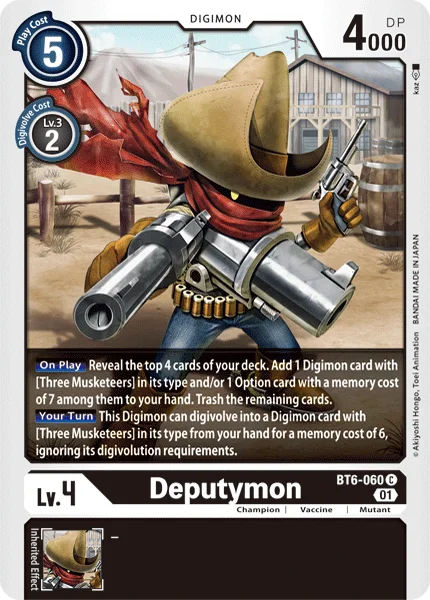
- BT6-060 Deputymon: "[Your Turn] this Digimon may digivolve into a Digimon card with the [Three Musketeers] trait **in your hand**, ignoring its digivolution requirements, with a digivolution cost of 6"
→ "In your hand" is specified, so a used Option card — which is in no area — can't be chosen (Q6236).
- BT25-082 BlackGatomon: "[All Turns] while you have a Tamer with [Three Musketeers] in its text, this Digimon may digivolve into a Digimon card with the [Three Musketeers] trait, ignoring its digivolution requirements, with a digivolution cost of 4"
→ No location requirement. After using Fly Bullet (BT25-083's Option side, a dual card), BlackGatomon can digivolve into that Beelstarmon via Arts Digivolve (Q6390).
The crux: **check whether the text specifies a location** ("in your hand" / "in the battle area"). The "used = no area" rule only bites when the text tries to reference that area.
- The card can't be referenced as "a card in your hand" or "a card in the battle area"
- Arts Digivolve stacks it via its own route (the official rule/revised procedure), which is why it clears the area-reference problem
[Real-card contrast] the presence of a location requirement changes everything
- BT6-060 Deputymon: "[Your Turn] this Digimon may digivolve into a Digimon card with the [Three Musketeers] trait **in your hand**, ignoring its digivolution requirements, with a digivolution cost of 6"
→ "In your hand" is specified, so a used Option card — which is in no area — can't be chosen (Q6236).
- BT25-082 BlackGatomon: "[All Turns] while you have a Tamer with [Three Musketeers] in its text, this Digimon may digivolve into a Digimon card with the [Three Musketeers] trait, ignoring its digivolution requirements, with a digivolution cost of 4"
→ No location requirement. After using Fly Bullet (BT25-083's Option side, a dual card), BlackGatomon can digivolve into that Beelstarmon via Arts Digivolve (Q6390).
The crux: **check whether the text specifies a location** ("in your hand" / "in the battle area"). The "used = no area" rule only bites when the text tries to reference that area.


The classification flow
When in doubt, walk this order:
1. What state is the card in right now?
- In hand or trash → it's just a card
- Being used in an area → an Option (the no-area state of 9-1-4/9-1-5)
- In an area as a digivolved Digimon → a Digimon
- Linked → part of the linked Digimon (link effects are activated by that Digimon)
2. What is the SOURCE activating the effect?
- Activating as a Digimon → Digimon effect (15-2-1-1)
- Activating as an Option card → Option effect (15-2-1-3)
3. Cross-check against restrictions
- "Your opponent can't play Digimon by effects" → only Digimon-playing acts are caught (playing via an Option effect may slip through)
- "Isn't affected by Digimon effects" → Option effects still land
Sections & resources:
- 15-2-1-1 (Digimon effects) / 15-2-1-3 (Option card effects)
- 4-2-5 (Digimon gain link effects)
- 9-1-4, 9-1-5 (used Options are in no area)
- Official: digimoncard.com/rule/revised/
1. What state is the card in right now?
- In hand or trash → it's just a card
- Being used in an area → an Option (the no-area state of 9-1-4/9-1-5)
- In an area as a digivolved Digimon → a Digimon
- Linked → part of the linked Digimon (link effects are activated by that Digimon)
2. What is the SOURCE activating the effect?
- Activating as a Digimon → Digimon effect (15-2-1-1)
- Activating as an Option card → Option effect (15-2-1-3)
3. Cross-check against restrictions
- "Your opponent can't play Digimon by effects" → only Digimon-playing acts are caught (playing via an Option effect may slip through)
- "Isn't affected by Digimon effects" → Option effects still land
Sections & resources:
- 15-2-1-1 (Digimon effects) / 15-2-1-3 (Option card effects)
- 4-2-5 (Digimon gain link effects)
- 9-1-4, 9-1-5 (used Options are in no area)
- Official: digimoncard.com/rule/revised/
Key point The classification follows the SOURCE at the moment of activation, not the card type. Linked = Digimon effect; being used = Option effect; fired by another card's effect = still an Option effect. Hold onto that principle and most dual card confusion evaporates.