
"By Doing X" and "Also": Does the Effect Chain or Not?
Skip the "by" condition and everything after dies; "also" stands alone
Connectives like "by doing X," "also," and "if" mean genuinely different things in effect text. Using EX5-023 WereGarurumon (X Antibody) and EX11-062 Shoto Kazama as examples, here's what chains and what stands alone, per Comprehensive Rules 15-6 and 15-7.
"By doing X" = an optional processing condition (15-7)
Comprehensive Rules 15-7-1:
When an effect has optional processing conditions, its text shows the conditions; if the player chooses to execute them and succeeds, the processing after the conditions can be executed.
So a "by doing X" condition is optional — you choose to do it or not. But decline it, and **nothing after it activates at all**.
When an effect has optional processing conditions, its text shows the conditions; if the player chooses to execute them and succeeds, the processing after the conditions can be executed.
So a "by doing X" condition is optional — you choose to do it or not. But decline it, and **nothing after it activates at all**.
Example 1: Skip the "by," lose everything after (EX5-023 Q3583)
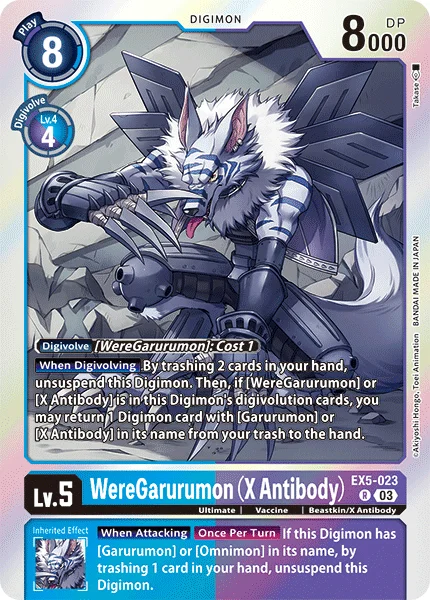
EX5-023 WereGarurumon (X Antibody)'s [When Digivolving] effect:
"By trashing 2 cards in your hand, unsuspend this Digimon. After that, if this Digimon has [WereGarurumon] or [X Antibody] in its digivolution cards, you may return 1 Digimon card with [Garurumon] or [X Antibody] in its name from your trash to the hand."
The Q3583 verdict:
- "By trashing 2 cards in your hand" is an optional processing condition
- Decline the trash, and neither the unsuspend NOR the "after that ... return to hand" happens — **none of it** (they chain off the condition)
Choose the 2-card trash and you get the unsuspend plus the recovery; decline and nothing happens.
"By trashing 2 cards in your hand, unsuspend this Digimon. After that, if this Digimon has [WereGarurumon] or [X Antibody] in its digivolution cards, you may return 1 Digimon card with [Garurumon] or [X Antibody] in its name from your trash to the hand."
The Q3583 verdict:
- "By trashing 2 cards in your hand" is an optional processing condition
- Decline the trash, and neither the unsuspend NOR the "after that ... return to hand" happens — **none of it** (they chain off the condition)
Choose the 2-card trash and you get the unsuspend plus the recovery; decline and nothing happens.

Example 2: "Also" stands alone (EX11-062 Q6517)
EX11-062 Shoto Kazama's [All Turns] effect:
"When a Digimon is suspended, by suspending this Tamer, if that Digimon was suspended by an effect, <Draw 1>. Also, until the end of your opponent's turn, 1 of your Digimon with [Bird] in one of its traits or the [Vortex Warriors] trait gets +3000 DP."
The Q6517 verdict:
- "By suspending this Tamer" is the optional condition → decline it and nothing after activates
- "If that Digimon was suspended by an effect, <Draw 1>" carries a processing condition ("if")
- "Also, ... +3000 DP" is **a separate process, independent of that condition**
- Basis 15-6-2: a processing condition binds only its own process; other processes in the same effect don't need to satisfy it
So even when the Digimon wasn't suspended by an effect (no <Draw 1> for you), the "also, +3000 DP" still executes.
"When a Digimon is suspended, by suspending this Tamer, if that Digimon was suspended by an effect, <Draw 1>. Also, until the end of your opponent's turn, 1 of your Digimon with [Bird] in one of its traits or the [Vortex Warriors] trait gets +3000 DP."
The Q6517 verdict:
- "By suspending this Tamer" is the optional condition → decline it and nothing after activates
- "If that Digimon was suspended by an effect, <Draw 1>" carries a processing condition ("if")
- "Also, ... +3000 DP" is **a separate process, independent of that condition**
- Basis 15-6-2: a processing condition binds only its own process; other processes in the same effect don't need to satisfy it
So even when the Digimon wasn't suspended by an effect (no <Draw 1> for you), the "also, +3000 DP" still executes.

"If" (processing condition, 15-6) vs. "by" (optional condition, 15-7)
The two confusable condition constructs:
- "If ..." / "while ..." = **processing condition** (15-6-1)
Gate for ONE process. No player choice: condition holds → execute; doesn't → skip. **Other processes in the same effect don't need to satisfy it** (15-6-2).
- "By doing ..." = **optional processing condition** (15-7-1)
Player's choice. Decline it and **everything after it is dead** (the chain stops).
One effect text can carry both — parse "by," "if," and "also" each on their own terms.
- "If ..." / "while ..." = **processing condition** (15-6-1)
Gate for ONE process. No player choice: condition holds → execute; doesn't → skip. **Other processes in the same effect don't need to satisfy it** (15-6-2).
- "By doing ..." = **optional processing condition** (15-7-1)
Player's choice. Decline it and **everything after it is dead** (the chain stops).
One effect text can carry both — parse "by," "if," and "also" each on their own terms.
Reading order at the table
Parse an effect in this order:
1. Find "by doing X" → decline it and everything after is gone
2. Find "if" / "while" → the gate for that one process
3. Find "after that," / "also," → check whether the next process stands alone
4. Check each ending: imperative = mandatory, "may" = optional
"Also" especially LOOKS tied to the preceding "by"/"if" — in practice it's usually an independent process.
1. Find "by doing X" → decline it and everything after is gone
2. Find "if" / "while" → the gate for that one process
3. Find "after that," / "also," → check whether the next process stands alone
4. Check each ending: imperative = mandatory, "may" = optional
"Also" especially LOOKS tied to the preceding "by"/"if" — in practice it's usually an independent process.
Relevant Comprehensive Rules sections
- 15-6-1 (processing conditions: "if" / "while")
- 15-6-2 (a processing condition binds one process only)
- 15-6-3 (an effect that satisfies none of its processing conditions can't activate)
- 15-7-1 (optional processing conditions: "by doing ...")
- 15-7-3 (no partial execution of optional processing conditions)
- 15-1-4 (an effect with multiple processes resolves after all of them)
- 15-6-2 (a processing condition binds one process only)
- 15-6-3 (an effect that satisfies none of its processing conditions can't activate)
- 15-7-1 (optional processing conditions: "by doing ...")
- 15-7-3 (no partial execution of optional processing conditions)
- 15-1-4 (an effect with multiple processes resolves after all of them)
Key point "By doing X" (optional condition): decline it and everything downstream is dead. "If" (processing condition): gates just its own clause. "Also": an independent process. Endings: imperative = mandatory, "may" = optional. Keep those four distinctions and any wall of text parses cleanly.