

"When This Digimon Wins a Battle" and Simultaneous Triggers, Done Right
Battle-win effects vs. [On Deletion] effects — who resolves first?
The moment a Digimon with a "when this Digimon wins a battle" effect — like BT25-054 GreatGrizzlymon — defeats an opponent's Digimon, the loser's [On Deletion] effect triggers at the same time. Which goes first? Comprehensive Rules 15-4-3-5-1 (turn player first) settles it.
Battle basics: compare DP, lose, be deleted
A battle is a game rule, not an effect (14-2-1).
- Compare DP
- The lower DP loses
- The loser is deleted
The winner's "wins a battle" effect and the loser's [On Deletion] effect trigger **simultaneously** — both are trigger-type effects reacting to the same battle outcome.
- Compare DP
- The lower DP loses
- The loser is deleted
The winner's "wins a battle" effect and the loser's [On Deletion] effect trigger **simultaneously** — both are trigger-type effects reacting to the same battle outcome.
Resolution order: turn player first (BT25-054 Q6334)
When BT25-054 GreatGrizzlymon's "wins a battle" effect and the defeated Digimon's [On Deletion] effect trigger simultaneously, the order is (Q6334):
- 15-4-3-5-1: 1 effect is chosen to activate from among the turn player's simultaneously triggered effects; repeat until the turn player has no pending effects, then move to the non-turn player
Which means:
- Win the battle during your own turn → your "wins a battle" effect resolves first
- Win during the opponent's turn (counter timing, etc.) → the opponent (the turn player) resolves first
- 15-4-3-5-1: 1 effect is chosen to activate from among the turn player's simultaneously triggered effects; repeat until the turn player has no pending effects, then move to the non-turn player
Which means:
- Win the battle during your own turn → your "wins a battle" effect resolves first
- Win during the opponent's turn (counter timing, etc.) → the opponent (the turn player) resolves first

Why order matters in real games
A single ordering can swing the game. Examples:
- "When this Digimon wins a battle, trash the top card of your opponent's security stack" → resolve it first and the trash is guaranteed
- If the loser's [On Deletion] reads "delete 1 of your opponent's Digimon," your winner could get deleted in return
- As turn player, you resolve first — sequence for maximum value
On the opponent's turn it flips: their [On Deletion] goes first, and your "wins a battle" effect resolves after your Digimon may already be gone (the winner doesn't need to survive — a triggered effect activates from pending even if its source left).
- "When this Digimon wins a battle, trash the top card of your opponent's security stack" → resolve it first and the trash is guaranteed
- If the loser's [On Deletion] reads "delete 1 of your opponent's Digimon," your winner could get deleted in return
- As turn player, you resolve first — sequence for maximum value
On the opponent's turn it flips: their [On Deletion] goes first, and your "wins a battle" effect resolves after your Digimon may already be gone (the winner doesn't need to survive — a triggered effect activates from pending even if its source left).
Related: inherited effects joining the deletion
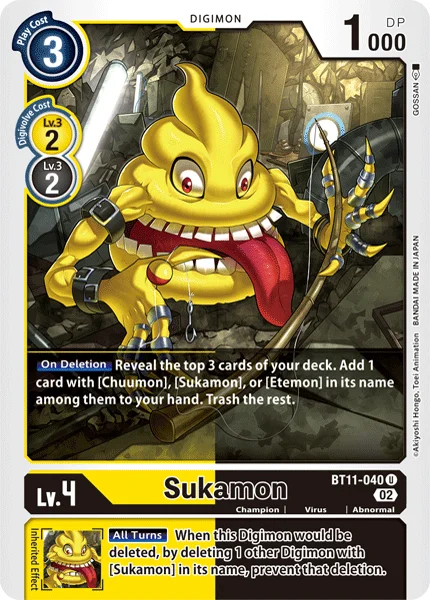
Effects can chain on deletion — see BT11-040 Sukamon's inherited effect. Details in the companion column on leaving the battle area.
- When "wins a battle" and multiple inherited [On Deletion] effects all trigger together, the same 15-4-3-5-1 rule applies: turn player's effects first, one at a time
- When immediate-type effects interject ("doesn't get deleted" and friends), the resolution grows another layer
Master the base pattern — battle win → simultaneous triggers → turn player first — and the advanced cases follow.
- When "wins a battle" and multiple inherited [On Deletion] effects all trigger together, the same 15-4-3-5-1 rule applies: turn player's effects first, one at a time
- When immediate-type effects interject ("doesn't get deleted" and friends), the resolution grows another layer
Master the base pattern — battle win → simultaneous triggers → turn player first — and the advanced cases follow.
Relevant Comprehensive Rules sections
- 14-2-1 (battle: comparing DP)
- 15-4-3-5-1 (simultaneous triggers: turn player activates first)
- 15-8-3 (trigger-type simultaneity)
- 15-16-6 ([On Deletion] timing)
The checklist:
1. Battle resolves → DP comparison → deletion
2. "Wins a battle" and [On Deletion] trigger simultaneously
3. The turn player activates their effects in any order they like
4. Once the turn player is done, the non-turn player resolves
- 15-4-3-5-1 (simultaneous triggers: turn player activates first)
- 15-8-3 (trigger-type simultaneity)
- 15-16-6 ([On Deletion] timing)
The checklist:
1. Battle resolves → DP comparison → deletion
2. "Wins a battle" and [On Deletion] trigger simultaneously
3. The turn player activates their effects in any order they like
4. Once the turn player is done, the non-turn player resolves
Key point "Wins a battle" effects swing on resolution order. Remember 15-4-3-5-1 — your turn: you first; their turn: them first — and you can predict the whole exchange before you commit to the battle.