
Why Multiple "Attack at End of Turn" Digimon Still Only Get One Attack
<Vortex>, Marcus Damon & Agumon, and inherited Tyrannomon — the processing rules
Line up several <Vortex> Digimon, or two AD1-021 Marcus Damon & Agumon with their [End of Your Turn] effects, and it feels like everyone should get to attack. In reality, exactly one Digimon attacks. The cause is the combination of simultaneous trigger resolution and Comprehensive Rules 11-2-4: no new attack declarations during an attack. Understanding it changes how you build and play.
The conclusion first: one attack; the rest get their "non-attack" parts
When multiple cards with "may attack at end of turn" effects (or multiple copies of the same inherited effect) are present, all of them trigger simultaneously at end of turn. However—
- Only the FIRST one actually attacks
- The second and later ones fail the "attack" part of their effect
- BUT the non-attack parts (becoming a Digimon, DP+, gaining <Rush>, etc.) all still apply for every copy
This is the correct behavior derived from official rules — not a bug, not an oversight.
- Only the FIRST one actually attacks
- The second and later ones fail the "attack" part of their effect
- BUT the non-attack parts (becoming a Digimon, DP+, gaining <Rush>, etc.) all still apply for every copy
This is the correct behavior derived from official rules — not a bug, not an oversight.
Reason 1: Simultaneous triggers resolve one at a time
Both [End of Your Turn] (15-16-12-1) and <Vortex> (16-33-1: "at the end of your turn, this Digimon may attack your opponent's Digimon") are trigger-type effects that trigger at end of turn.
When several Digimon meet the same condition, they trigger simultaneously, and the turn player picks the order and resolves them one by one.
The moment the first one chooses to attack, that Digimon's attack begins.
When several Digimon meet the same condition, they trigger simultaneously, and the turn player picks the order and resolves them one by one.
The moment the first one chooses to attack, that Digimon's attack begins.
Reason 2: No new attack declarations during an attack (11-2-4)
Comprehensive Rules 11-2-4:
"A new attack declaration can't be made during an attack. (Example: A new attack declaration can't be made using <Blitz> during an attack.)"
Once the first Digimon declares an attack, no other attack can be declared until that attack fully ends (counter timing → block timing → confirmation → end of attack).
When the second pending effect's turn comes, it finds itself mid-attack — its attack portion simply fails.
"A new attack declaration can't be made during an attack. (Example: A new attack declaration can't be made using <Blitz> during an attack.)"
Once the first Digimon declares an attack, no other attack can be declared until that attack fully ends (counter timing → block timing → confirmation → end of attack).
When the second pending effect's turn comes, it finds itself mid-attack — its attack portion simply fails.
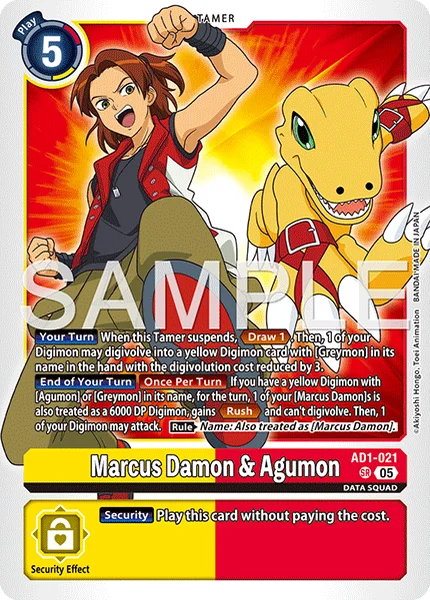
Example 1: Two AD1-021 Marcus Damon & Agumon (Q6110)
Two copies of AD1-021 Marcus Damon & Agumon in the battle area.
At end of turn, both [End of Your Turn] effects trigger simultaneously.
- 1st copy: becomes a 6000 DP Digimon + gains <Rush> + may attack
- The 1st declares an attack; the attack begins
- 2nd copy's turn: becomes a 6000 DP Digimon + gains <Rush> (this much applies) → the attack part fails via 11-2-4
Result: **one attack, but two Digimon transformations with 6000 DP and <Rush>**.
At end of turn, both [End of Your Turn] effects trigger simultaneously.
- 1st copy: becomes a 6000 DP Digimon + gains <Rush> + may attack
- The 1st declares an attack; the attack begins
- 2nd copy's turn: becomes a 6000 DP Digimon + gains <Rush> (this much applies) → the attack part fails via 11-2-4
Result: **one attack, but two Digimon transformations with 6000 DP and <Rush>**.
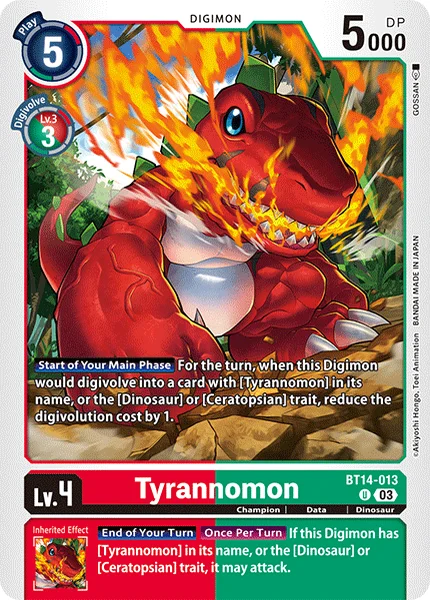
Example 2: Inherited BT14-013 Tyrannomon (Q2378)
Inherited effects behave the same.
With two Digimon carrying BT14-013 Tyrannomon in their digivolution cards, both inherited effects trigger at end of turn. As soon as the first declares an attack, the second finds itself mid-attack and fails.
Intuition says inherited effects are somehow independent — they aren't. Inherited effects follow the same activation rules as everything else.
With two Digimon carrying BT14-013 Tyrannomon in their digivolution cards, both inherited effects trigger at end of turn. As soon as the first declares an attack, the second finds itself mid-attack and fails.
Intuition says inherited effects are somehow independent — they aren't. Inherited effects follow the same activation rules as everything else.
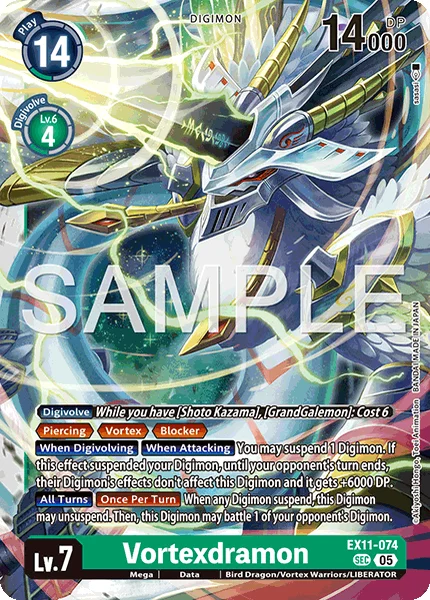
Example 3: Multiple <Vortex> Digimon (16-33-1)
The <Vortex> text: "At the end of your turn, this Digimon may attack your opponent's Digimon. This effect also allows it to attack on the turn it was played" (16-33-1).
It operates as a trigger-type effect (16-33-2), so multiple <Vortex> Digimon all trigger at end of turn — and still, only one attacks.
Also, <Vortex> is optional processing (16-33-3). You can decline the attack, so sometimes the right play is to pass on the first Digimon and attack with a stronger second one.
It operates as a trigger-type effect (16-33-2), so multiple <Vortex> Digimon all trigger at end of turn — and still, only one attacks.
Also, <Vortex> is optional processing (16-33-3). You can decline the attack, so sometimes the right play is to pass on the first Digimon and attack with a stronger second one.
How to use this in real games
- Build decks assuming ONE attack per end-of-turn, no matter how many attack-at-end effects you stack
- The non-attack parts (DP+, <Rush>, token generation...) do stack per copy — read the text and they're not wasted
- If <Vortex> is optional, you may skip the first activation and attack with a better body (16-33-3)
- As the defender, budget your resources knowing the second attack isn't coming
- <Blitz> (attacking at counter timing etc.) obeys the same 11-2-4 — reuse this article's logic for similar cards
- The non-attack parts (DP+, <Rush>, token generation...) do stack per copy — read the text and they're not wasted
- If <Vortex> is optional, you may skip the first activation and attack with a better body (16-33-3)
- As the defender, budget your resources knowing the second attack isn't coming
- <Blitz> (attacking at counter timing etc.) obeys the same 11-2-4 — reuse this article's logic for similar cards
Rules sections and the checklist
The checklist (walk it in order):
1. Is "may attack at end of turn" a trigger-type effect? (15-16-12-1 / 16-33-2: yes)
2. Did several trigger at the same timing? (process as simultaneous triggers)
3. The moment the 1st declares an attack, the rest collide with 11-2-4
4. The non-attack parts still apply for every copy
5. Optional effects like <Vortex> can be declined (16-33-3)
Sections:
- 15-16-12-1 ([End of Your Turn] timing)
- 16-33-1, 16-33-2, 16-33-3 (<Vortex> = trigger-type, optional)
- 11-2-3 (one attack declaration, one Digimon)
- 11-2-4 (no new attack declarations during an attack)
- 15-8-3 (trigger-type simultaneity and resolution order)
1. Is "may attack at end of turn" a trigger-type effect? (15-16-12-1 / 16-33-2: yes)
2. Did several trigger at the same timing? (process as simultaneous triggers)
3. The moment the 1st declares an attack, the rest collide with 11-2-4
4. The non-attack parts still apply for every copy
5. Optional effects like <Vortex> can be declined (16-33-3)
Sections:
- 15-16-12-1 ([End of Your Turn] timing)
- 16-33-1, 16-33-2, 16-33-3 (<Vortex> = trigger-type, optional)
- 11-2-3 (one attack declaration, one Digimon)
- 11-2-4 (no new attack declarations during an attack)
- 15-8-3 (trigger-type simultaneity and resolution order)
Key point "Two <Vortex> Digimon = two attacks" is a myth. One attack only — but the DP boosts, <Rush> grants, and token generation all fire for every copy. Split each effect into its "attack part" and "everything else" when you read it.