
"When This Digimon Would Leave" Effects and Simultaneous Triggers, Done Right
Why <Evade> and "doesn't leave" effects can activate again and again
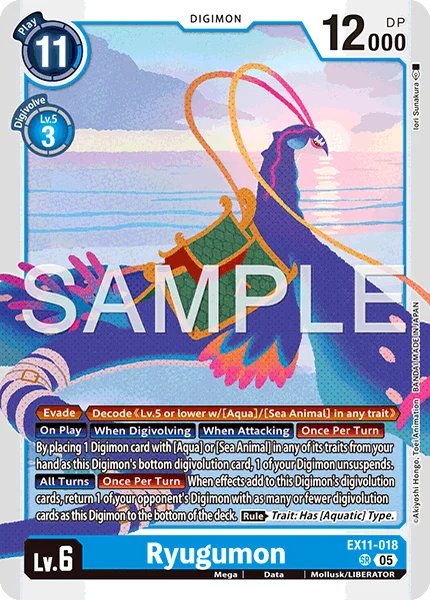
Immediate-type effects like "when this Digimon would leave the battle area" or "when this Digimon would be deleted" — see EX11-018 Ryugumon and EX11-012 Medusamon — can activate multiple times depending on the situation. What looks like a rules violation is completely consistent once you read the official 2025 immediate-type ruling update and Chapter 17 (rule checks).
First things first: "would leave" is an immediate-type effect
Effects written "when this Digimon would be deleted / would leave the battle area" are classified as immediate-type effects (15-8-1). Their key properties:
- Unlike normal trigger-type effects, they don't join the pending queue — they interrupt
- Immediate-type effects only trigger simultaneously with other immediate-type effects (15-8-5-3)
- Each immediate-type effect can be activated one at a time until the cause that first interrupted it is resolved (15-8-5-4)
That "one at a time until resolved" clause is what matters later.
- Unlike normal trigger-type effects, they don't join the pending queue — they interrupt
- Immediate-type effects only trigger simultaneously with other immediate-type effects (15-8-5-3)
- Each immediate-type effect can be activated one at a time until the cause that first interrupted it is resolved (15-8-5-4)
That "one at a time until resolved" clause is what matters later.
THE key change: the official 2025 ruling update
Bandai's official "Immediate-type effect ruling update" (digimoncard.com/rule/immediate/) defines today's behavior. The updated rule boils down to one sentence:
"Until the first process that occurred resolves, every immediate-type effect can interrupt and activate once each. However, even within a single effect that causes multiple processes, each time one process resolves, immediate-type effects can activate once more."
The unit of judgment is the PROCESS, not the effect.
- "Delete 1 of your opponent's Digimon" → one process → immediate-type effects interrupt once
- "Delete all of your opponent's Digimon" → a process per Digimon → immediate-type effects can activate once per process
[Once Per Turn] limits still can't be exceeded, even under this update.
"Until the first process that occurred resolves, every immediate-type effect can interrupt and activate once each. However, even within a single effect that causes multiple processes, each time one process resolves, immediate-type effects can activate once more."
The unit of judgment is the PROCESS, not the effect.
- "Delete 1 of your opponent's Digimon" → one process → immediate-type effects interrupt once
- "Delete all of your opponent's Digimon" → a process per Digimon → immediate-type effects can activate once per process
[Once Per Turn] limits still can't be exceeded, even under this update.
Example 1: Deletion at 0 DP (Ryugumon Q6515)
With EX11-018 Ryugumon, here's what happens when DP hits 0:
- A rule check tries to delete the 0 DP Digimon (17-1-3-1-1)
- <Evade> and <Decode> trigger simultaneously (both immediate-type)
- Activate <Decode> → play a Digimon
- Activate <Evade> → the Digimon isn't deleted
- If DP is still 0 afterward, a second rule check occurs
- <Evade> and <Decode> can activate again there
The point: every rule check resets the immediate-type allowance. Exactly as the official update says — one more activation each time a process resolves.
- A rule check tries to delete the 0 DP Digimon (17-1-3-1-1)
- <Evade> and <Decode> trigger simultaneously (both immediate-type)
- Activate <Decode> → play a Digimon
- Activate <Evade> → the Digimon isn't deleted
- If DP is still 0 afterward, a second rule check occurs
- <Evade> and <Decode> can activate again there
The point: every rule check resets the immediate-type allowance. Exactly as the official update says — one more activation each time a process resolves.

Example 2: Sacrificing a token to stay (Medusamon Q6514)
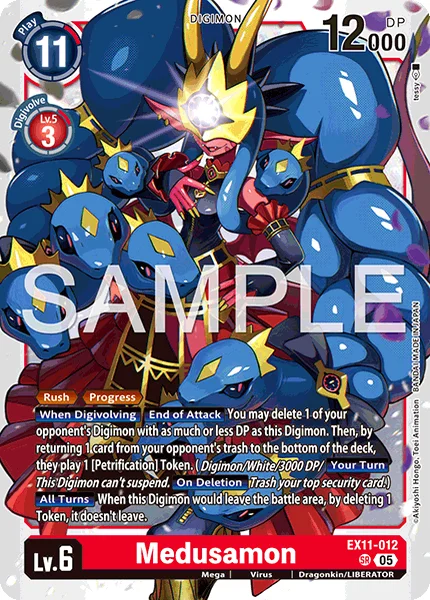
EX11-012 Medusamon's [All Turns] "when this Digimon would leave the battle area, by deleting 1 of your tokens, it doesn't leave" runs on the same logic as Q6515.
- Rule-check deletion at 0 DP → activate the effect, delete a token, stay
- If DP is still 0, the effect can activate again on the second rule check
- Careful: if the deleted token has an [On Deletion] effect, those trigger simultaneously after ALL the rule checks finish
This is where "simultaneous" vs. "sequential" pays off: immediate-type interrupts the process, trigger-type lines up after the rule checks are done.
- Rule-check deletion at 0 DP → activate the effect, delete a token, stay
- If DP is still 0, the effect can activate again on the second rule check
- Careful: if the deleted token has an [On Deletion] effect, those trigger simultaneously after ALL the rule checks finish
This is where "simultaneous" vs. "sequential" pays off: immediate-type interrupts the process, trigger-type lines up after the rule checks are done.
Example 3: "Protect everyone" vs. "choose one" — a decisive wording difference
The same "doesn't leave" concept behaves completely differently depending on the wording. Compare real cards:
[Protect-everyone type] no card is chosen; the effect covers everything
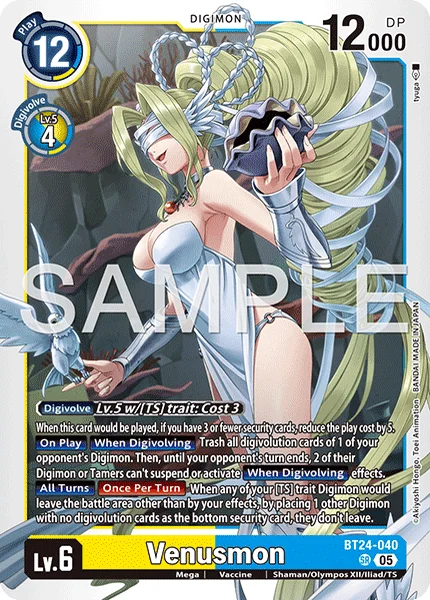
- BT24-040 Venusmon (Q5621): "when your Digimon with the [TS] trait ... would leave, by placing 1 of your other Digimon without digivolution cards at the bottom of your security stack, they don't leave"
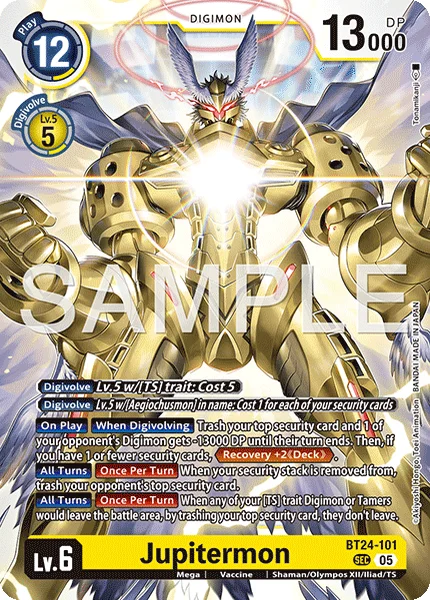
- BT24-101 Jupitermon (Q5718): "when your Digimon/Tamer with the [TS] trait would leave the battle area, by trashing the top card of your security stack, they don't leave"
One activation protects everyone leaving at that moment.
[Choose-one type] the text says "1 of them"
- ST22-10 Amethyst Mandala's {Security} [All Turns] effect (Q5438): "...when your Digimon would leave, by trashing this card, 1 of those Digimon doesn't leave"
One activation saves exactly one Digimon. If several leave at once, the chosen one stays — the rest go.
- One word in the text ("1 of them" present or not) completely changes the outcome. Read before you play.
[Protect-everyone type] no card is chosen; the effect covers everything
- BT24-040 Venusmon (Q5621): "when your Digimon with the [TS] trait ... would leave, by placing 1 of your other Digimon without digivolution cards at the bottom of your security stack, they don't leave"
- BT24-101 Jupitermon (Q5718): "when your Digimon/Tamer with the [TS] trait would leave the battle area, by trashing the top card of your security stack, they don't leave"
One activation protects everyone leaving at that moment.
[Choose-one type] the text says "1 of them"
- ST22-10 Amethyst Mandala's {Security} [All Turns] effect (Q5438): "...when your Digimon would leave, by trashing this card, 1 of those Digimon doesn't leave"
One activation saves exactly one Digimon. If several leave at once, the chosen one stays — the rest go.
- One word in the text ("1 of them" present or not) completely changes the outcome. Read before you play.

[Security] effects vs. {Security} effects (important)
To understand ST22-10's Q5437 you must distinguish two confusingly similar mechanics:
- [Security] effects (15-16-10-1)
Trigger the moment the card is CHECKED during a security check. They fire once and are done.
Example: the [Security] effects on most Lv.4 Digimon cards.
- {Security} effects (15-14-5-1)
"Can trigger and activate while the card is placed FACE-UP in the security stack." As long as it stays face-up there, it can trigger every time its condition is met.
ST22-10 Amethyst Mandala's own [Main] effect includes "place this card face up at the bottom of your security stack," plus a [Security] effect that re-activates itself when trashed from security by an effect.
So while it sits face-up in security, its {Security} [All Turns] effect can trigger on every "would leave" — and only then does Q5437 even come into play.
- [Security] effects (15-16-10-1)
Trigger the moment the card is CHECKED during a security check. They fire once and are done.
Example: the [Security] effects on most Lv.4 Digimon cards.
- {Security} effects (15-14-5-1)
"Can trigger and activate while the card is placed FACE-UP in the security stack." As long as it stays face-up there, it can trigger every time its condition is met.
ST22-10 Amethyst Mandala's own [Main] effect includes "place this card face up at the bottom of your security stack," plus a [Security] effect that re-activates itself when trashed from security by an effect.
So while it sits face-up in security, its {Security} [All Turns] effect can trigger on every "would leave" — and only then does Q5437 even come into play.
Example 4: Multiple face-up copies in security (Amethyst Mandala Q5437 / Q5438)
Setup: multiple face-up ST22-10 Amethyst Mandala in your security stack.
[Q5437: after resolving the 1st, the 2nd can still activate]
When your Digimon whose name contains [Renamon]/[Kyubimon]/[Taomon]/[Sakuyamon] would leave, the {Security} [All Turns] effects of ALL face-up copies trigger simultaneously. Even after the 1st resolves and the Digimon no longer leaves, you may still activate the 2nd (immediate-type effects trigger together, and each resolved process re-opens the window — exactly the official update rule from the section above).
[Q5438: with several Digimon leaving at once, 1 copy = 1 Digimon]
Even when several Digimon would leave simultaneously, each ST22-10 reads "1 of those Digimon doesn't leave" — one copy protects exactly one. Two face-up copies protect up to two.
Takeaway: protect-everyone effects cover the whole board with one copy; choose-one effects scale only with copies. Stacking face-up security IS the strategy of this card.
[Q5437: after resolving the 1st, the 2nd can still activate]
When your Digimon whose name contains [Renamon]/[Kyubimon]/[Taomon]/[Sakuyamon] would leave, the {Security} [All Turns] effects of ALL face-up copies trigger simultaneously. Even after the 1st resolves and the Digimon no longer leaves, you may still activate the 2nd (immediate-type effects trigger together, and each resolved process re-opens the window — exactly the official update rule from the section above).
[Q5438: with several Digimon leaving at once, 1 copy = 1 Digimon]
Even when several Digimon would leave simultaneously, each ST22-10 reads "1 of those Digimon doesn't leave" — one copy protects exactly one. Two face-up copies protect up to two.
Takeaway: protect-everyone effects cover the whole board with one copy; choose-one effects scale only with copies. Stacking face-up security IS the strategy of this card.
Example 5: <Ascension> and [On Deletion] order choice (Amaterasumon Q6815)
EX12-047 Amaterasumon has both <Ascension> (when deleted, you may place this card on top of your security stack) and an [On Deletion] effect (return 1 TB card from trash to hand + play 1 TB Lv.5 or lower from hand). Both trigger on deletion — simultaneously.
- You choose the order, and **the wrong order silently kills one of them**.
- **[On Deletion] first → <Ascension> second**: refill your hand and board, then top up security. Both effects fully used — the correct line.
- **<Ascension> first → [On Deletion] second**: the card moves from trash to security → the [On Deletion] effect can no longer activate (the card left the trash, 15-4-4-3).
Even pure trigger-type pairs lose pending effects when the card body changes areas mid-chain. Amaterasumon is the poster child for "order choice deletes an effect" — if you want both, [On Deletion] goes first.
- You choose the order, and **the wrong order silently kills one of them**.
- **[On Deletion] first → <Ascension> second**: refill your hand and board, then top up security. Both effects fully used — the correct line.
- **<Ascension> first → [On Deletion] second**: the card moves from trash to security → the [On Deletion] effect can no longer activate (the card left the trash, 15-4-4-3).
Even pure trigger-type pairs lose pending effects when the card body changes areas mid-chain. Amaterasumon is the poster child for "order choice deletes an effect" — if you want both, [On Deletion] goes first.

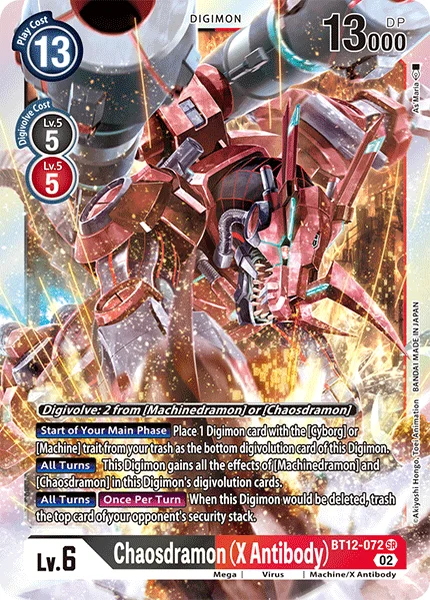
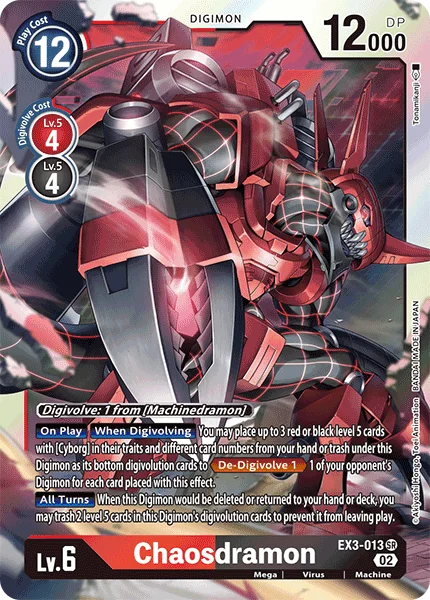
Example 6: One immediate effect after another (Chaosdramon X Antibody Q2212)
After activating BT12-072 Chaosdramon (X Antibody)'s "when this Digimon would be deleted, trash the top card of your opponent's security stack," you can then activate the inherited "doesn't get deleted" effect of EX3-013 Chaosdramon underneath (Q2212).
- Both are "would be deleted" immediate-type effects → simultaneous trigger
- Resolve them one at a time; neither is a precondition of the other
- Net result: trash one security AND survive
You choose the resolution order of simultaneous immediate-type effects, so sequence them to your advantage.
- Both are "would be deleted" immediate-type effects → simultaneous trigger
- Resolve them one at a time; neither is a precondition of the other
- Net result: trash one security AND survive
You choose the resolution order of simultaneous immediate-type effects, so sequence them to your advantage.
Rules sections and the checklist
The checklist (walk it in order):
1. Is the effect immediate-type? ("when ... would ...", "by ..., it doesn't ...")
2. Are other immediate-type effects triggering at the same timing? (simultaneous = 15-8-5-3)
3. Has the first process resolved? (official update: each resolved process re-opens one activation)
4. Is there a [Once Per Turn] limit? (the update never overrides it)
5. Does the effect choose a target or cover everyone? (the mass-exodus protection question)
Sections & sources:
- 15-8-1 (effect classification) / 15-8-5-3 (immediate-with-immediate simultaneity) / 15-8-5-4 (the once-per-cause rule)
- 17-1-1, 17-1-2-2, 17-1-3-1-1 (rule checks)
- 15-4-3-3 (rule checks and triggers)
- 15-16-10-1 ([Security] = once, on check)
- 15-14-5-1 ({Security} = anytime while face-up)
- Official: digimoncard.com/rule/immediate/ (the definitive immediate-type update)
1. Is the effect immediate-type? ("when ... would ...", "by ..., it doesn't ...")
2. Are other immediate-type effects triggering at the same timing? (simultaneous = 15-8-5-3)
3. Has the first process resolved? (official update: each resolved process re-opens one activation)
4. Is there a [Once Per Turn] limit? (the update never overrides it)
5. Does the effect choose a target or cover everyone? (the mass-exodus protection question)
Sections & sources:
- 15-8-1 (effect classification) / 15-8-5-3 (immediate-with-immediate simultaneity) / 15-8-5-4 (the once-per-cause rule)
- 17-1-1, 17-1-2-2, 17-1-3-1-1 (rule checks)
- 15-4-3-3 (rule checks and triggers)
- 15-16-10-1 ([Security] = once, on check)
- 15-14-5-1 ({Security} = anytime while face-up)
- Official: digimoncard.com/rule/immediate/ (the definitive immediate-type update)
Key point "Immediate-type effects only activate once" is half right, half wrong. The real rule: once per process, until that process resolves. In scenes with multiple processes — rule checks, board-wide deletions — the allowance resets per process. That's exactly why <Evade> can activate twice in Q6515.