

Revealed Cards, Checked Cards, Face-Up Cards: How Each Is Treated
"Reveal," "look at," and "face up" sorted out by the official rules
Effects like BT10-086 Omnimon (X Antibody)'s reveal the opponent's whole security stack; others reveal cards from the top of the deck. How revealed cards, face-up security cards, and looked-at cards are treated comes down to the combination of area + visibility. Sorted out via Chapters 3 and 4-6 of the Comprehensive Rules.
Public vs. private information
The Comprehensive Rules assign public/private status by area and card state:
- The deck (3-2-2), Digi-Egg deck (3-3-2), and security stack (3-7-2) are private areas — cards sit face-down
- The COUNT of cards in each area is public information (3-1-3-2)
- A card placed **face-up** in the security stack becomes public information (3-7-4)
- A face-down digivolution card is a card without information; nothing on it can be referenced (4-6-9)
"Reveal" and "face up" both build on these.
- The deck (3-2-2), Digi-Egg deck (3-3-2), and security stack (3-7-2) are private areas — cards sit face-down
- The COUNT of cards in each area is public information (3-1-3-2)
- A card placed **face-up** in the security stack becomes public information (3-7-4)
- A face-down digivolution card is a card without information; nothing on it can be referenced (4-6-9)
"Reveal" and "face up" both build on these.
Revealing from the top of the deck
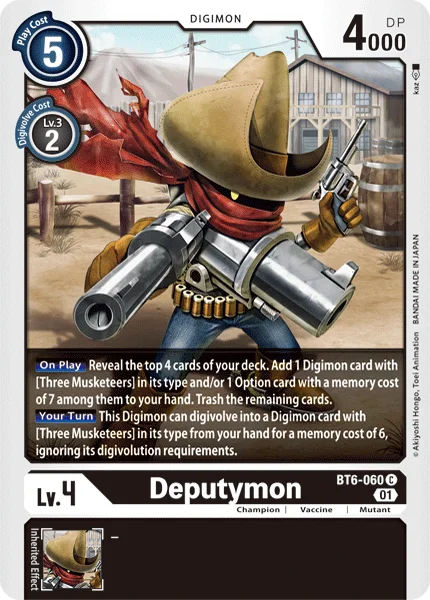
Effects like "reveal 4 cards from the top of your deck" (BT6-060 Deputymon's [On Play], for example) show cards to both players.
- Revealed cards stay revealed on the deck until the effect's processing (add to hand / trash / return) resolves
- A revealed card that gets trashed goes to the trash
- Once the processing resolves, leftovers follow the effect's instructions (trash, bottom of deck, etc.)
- Revealed cards stay revealed on the deck until the effect's processing (add to hand / trash / return) resolves
- A revealed card that gets trashed goes to the trash
- Once the processing resolves, leftovers follow the effect's instructions (trash, bottom of deck, etc.)
Revealing security: BT10-086 Omnimon (X Antibody) (Q2010)
BT10-086 Omnimon (X Antibody)'s [When Digivolving] [When Attacking] effect: "by returning 1 [X Antibody] or Lv.6 card from this Digimon's digivolution cards to the bottom of the deck, reveal your opponent's security stack. Trash 1 card among them. Place the rest back face-down."
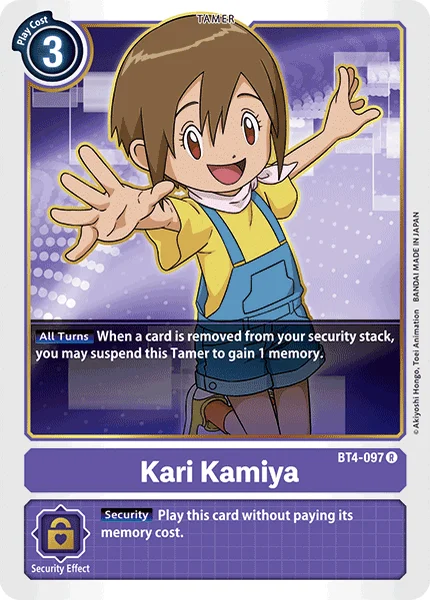
Q2010: when your security is revealed by the opponent's Omnimon (X Antibody) and 1 card is trashed, "when your security stack decreases" triggers (BT4-097 Kari Kamiya and the like) DO activate.
- "A card trashed while revealed from the deck or security is not considered trashed FROM the deck or security" (official answer)
- But the COUNT still went down — so "when your security stack decreases" conditions are met
The official split: "the revealed card was trashed" ≠ "the card was trashed from security" — while "the stack got smaller" is still true.
Q2010: when your security is revealed by the opponent's Omnimon (X Antibody) and 1 card is trashed, "when your security stack decreases" triggers (BT4-097 Kari Kamiya and the like) DO activate.
- "A card trashed while revealed from the deck or security is not considered trashed FROM the deck or security" (official answer)
- But the COUNT still went down — so "when your security stack decreases" conditions are met
The official split: "the revealed card was trashed" ≠ "the card was trashed from security" — while "the stack got smaller" is still true.

Face-up cards sitting in security
Cards like BT25-034 Angemon and ST22-10 Amethyst Mandala get placed **face-up** in the security stack by their own or other effects.
- A face-up card there is public information (3-7-4)
- Its {Security} effect (15-14-5-1) can trigger and activate while it stays face-up
- More in the companion column "The Security Trio, Untangled"
Note: "revealed" and "placed face up" are different concepts. Revealing is a momentary disclosure; face-up placement is an ongoing state.
- A face-up card there is public information (3-7-4)
- Its {Security} effect (15-14-5-1) can trigger and activate while it stays face-up
- More in the companion column "The Security Trio, Untangled"
Note: "revealed" and "placed face up" are different concepts. Revealing is a momentary disclosure; face-up placement is an ongoing state.


"Look at" vs. "reveal"
Effect text uses two disclosure verbs:
- "Look at ...": only that player sees the cards (the opponent doesn't)
- "Reveal ...": both players see them
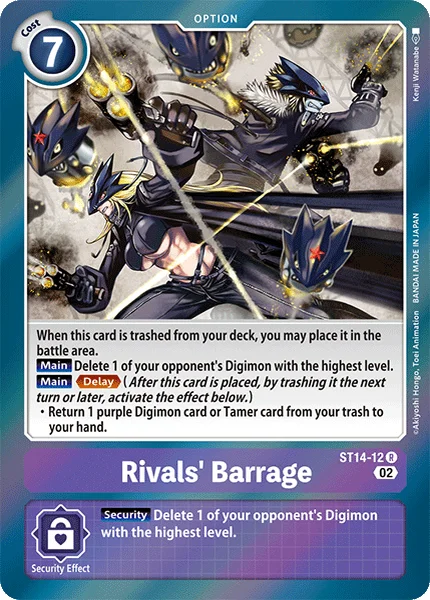
Related: <Delay> cards like ST14-12 Rivals' Barrage are "placed" — face-up in the battle area, fully public. "[Main] <Delay> (Trash this card on your next turn or later to activate its effect)" sits there as a face-up card.
- A placed <Delay> card is public information in the battle area
- While it's there, it's referenced as an Option card
- "Look at ...": only that player sees the cards (the opponent doesn't)
- "Reveal ...": both players see them
Related: <Delay> cards like ST14-12 Rivals' Barrage are "placed" — face-up in the battle area, fully public. "[Main] <Delay> (Trash this card on your next turn or later to activate its effect)" sits there as a face-up card.
- A placed <Delay> card is public information in the battle area
- While it's there, it's referenced as an Option card
Relevant Comprehensive Rules sections
- 3-1-3-2 (counts are public information)
- 3-7-2 (security is a private area)
- 3-7-4 (face-up security cards are public information)
- 4-6-9 (face-down stacked cards carry no information)
- 4-6-10 (only the owner may look at face-down cards)
- 15-14-5-1 ({Security} effects)
The checklist:
1. Which area is the card in?
2. Face-up or face-down?
3. Momentarily revealed, or placed face-up as a state?
4. Do "count decreased" triggers fire on mid-reveal trashes? (Q2010: yes)
- 3-7-2 (security is a private area)
- 3-7-4 (face-up security cards are public information)
- 4-6-9 (face-down stacked cards carry no information)
- 4-6-10 (only the owner may look at face-down cards)
- 15-14-5-1 ({Security} effects)
The checklist:
1. Which area is the card in?
2. Face-up or face-down?
3. Momentarily revealed, or placed face-up as a state?
4. Do "count decreased" triggers fire on mid-reveal trashes? (Q2010: yes)
Key point "Revealed" (a moment) and "placed face up" (a state) are different things. And a card trashed mid-reveal doesn't count as "trashed from security" — yet the stack still counts as having decreased (Q2010). Pin down the exact verb — reveal / look at / face up — every time.